Portrait Photography — Framing & Field of View
At human scale, TBS-001 is a portrait camera: a person stands in front of the pinhole wall and is projected — inverted and reversed — onto the photosensitive film plane inside the container. This page collects the geometry of that capture: how wide a scene the camera takes in, how large a subject renders at a given distance, and where a portrait sits best.
The optics are the fixed pinhole — focal length f = 2,362mm (the container's interior depth), pinhole Ø2.17mm, f/1088 (the Rayleigh optimum). The image forms on the active film plane, 4,389 × 2,094mm, with the pinhole centered on the long wall at X ≈ 2,454mm — see the Film Plane Mechanism.
1. Field of view
The field of view is set by how much of the film plane the pinhole "sees" — the active plane's extent relative to the focal length:
- Horizontal FOV ≈ 86° — 2·atan((4,389 ÷ 2) ÷ 2,362)
- Vertical FOV ≈ 48° — 2·atan((2,094 ÷ 2) ÷ 2,362)
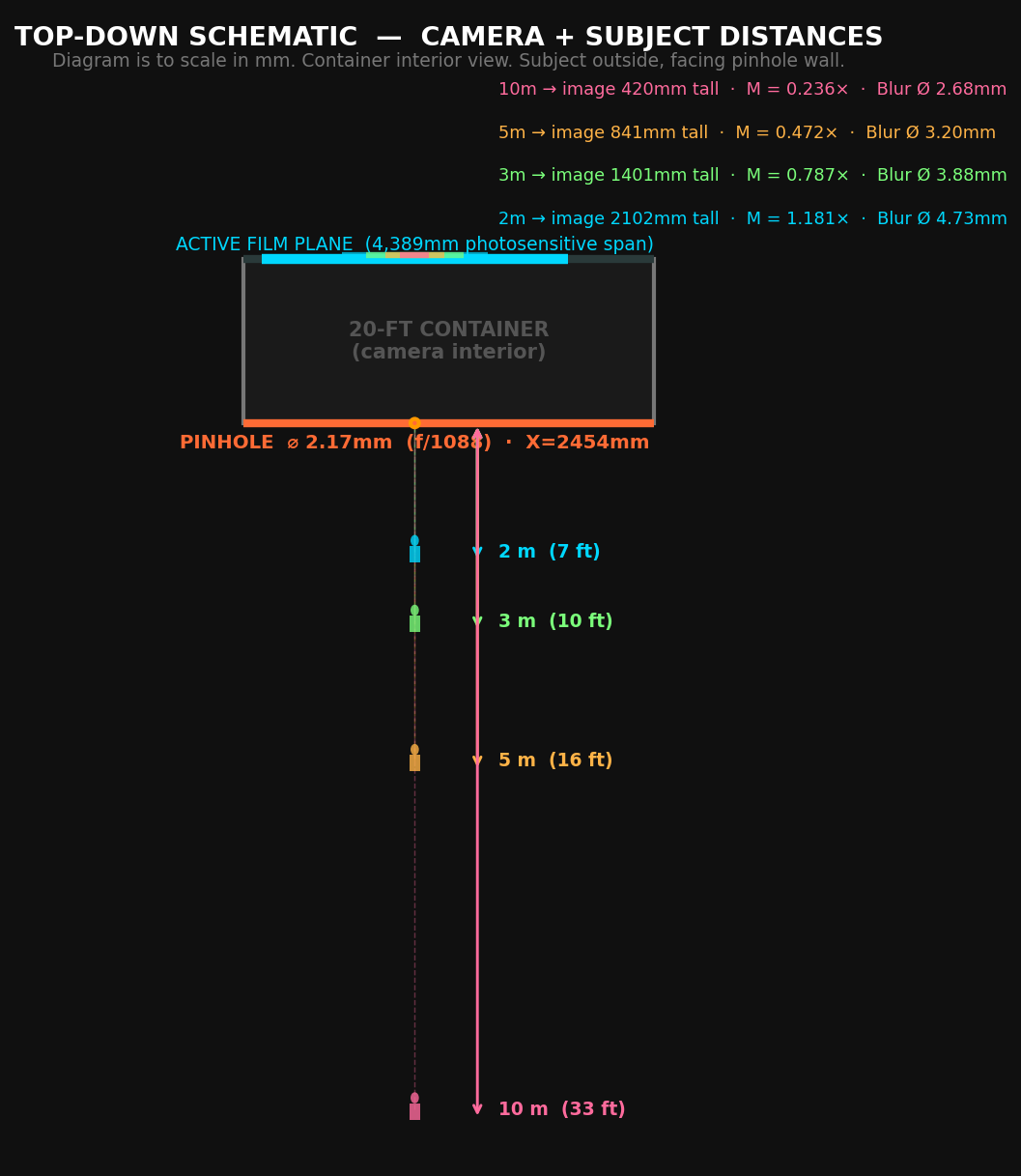
Subjects stand outside the pinhole wall, facing the camera. A standing adult fills the frame vertically at modest range; farther back, the figure shrinks and more of the surrounding scene enters.
2. Subject size vs distance
For a pinhole the projected image scales linearly: magnification M = f ÷ u (image size ÷ subject size, for a subject at distance u). A 1,780mm (5′10″) subject therefore projects to 1,780 · (2,362 ÷ u) mm on the film:
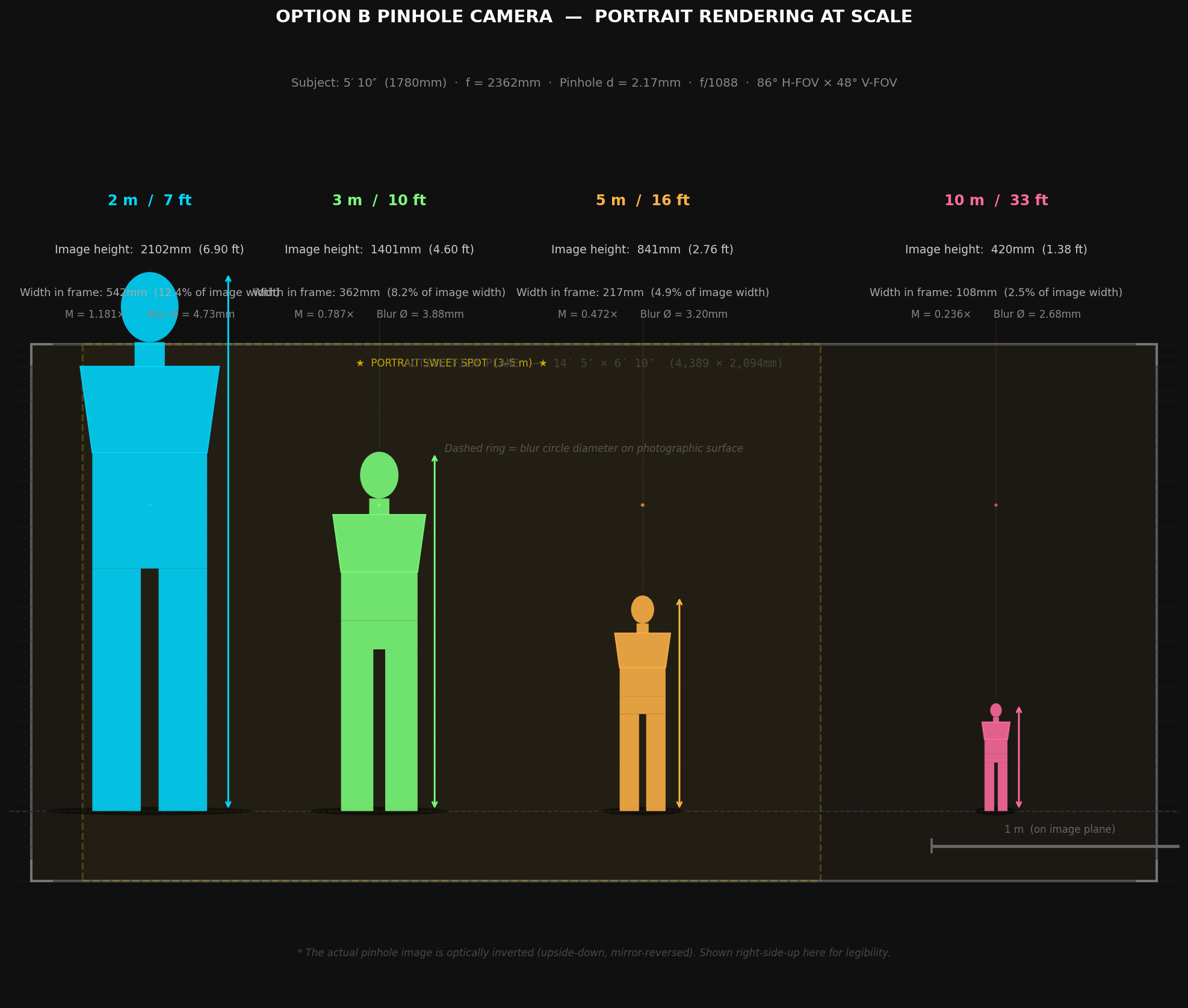
Closer subjects render larger (and eventually overflow the 2,094mm plane height); farther subjects render smaller with more context around them.
3. The optimal portrait distance
Sharpness is limited by the pinhole's geometric blur circle, B = 2.17 · (1 + f ÷ u) mm on the film — larger for nearer subjects, since the cone of light from each point of the subject spreads more on the way in. Trading framing against blur puts a comfortable full-figure portrait at roughly 3m:
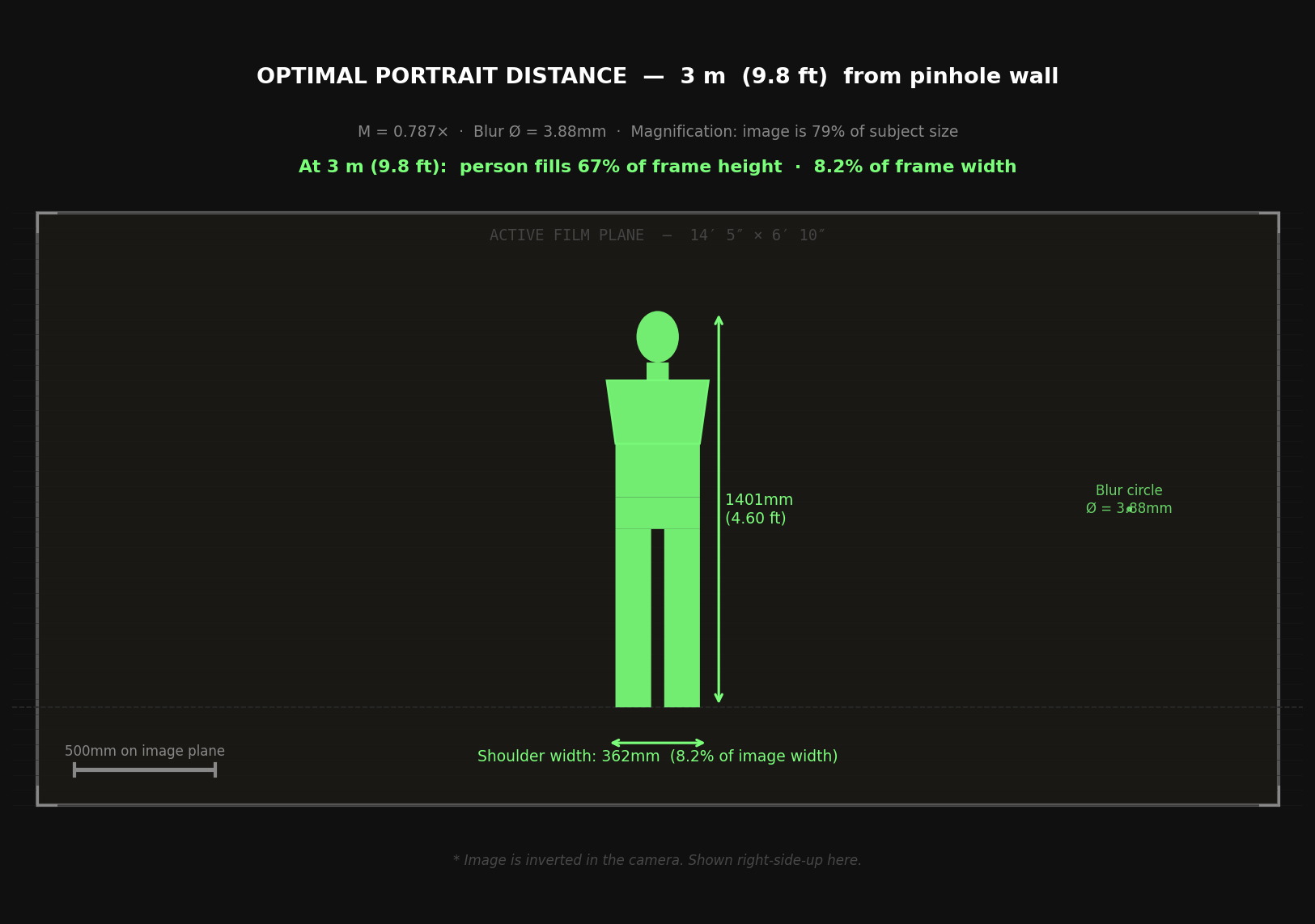
At 3m the image is M = 2,362 ÷ 3,000 ≈ 0.79× of the subject (a 1,780mm person → ~1,400mm image, inside the 2,094mm plane height) with a blur circle of B ≈ 2.17 · (1 + 2,362 ÷ 3,000) ≈ 3.9mm — soft by lens standards, and characteristic of the pinhole look.
See Also
- Optics Report — pinhole sizing, f-number, and resolution.
- Lens vs Pinhole Exposure — exposure and sharpness trade-offs.
- Distortion Renders — film-plane movement and perspective control.
- Film Plane Mechanism — the image plane and its dimensions.