Plywood Cut Sheets — TBS-001
1. Purpose
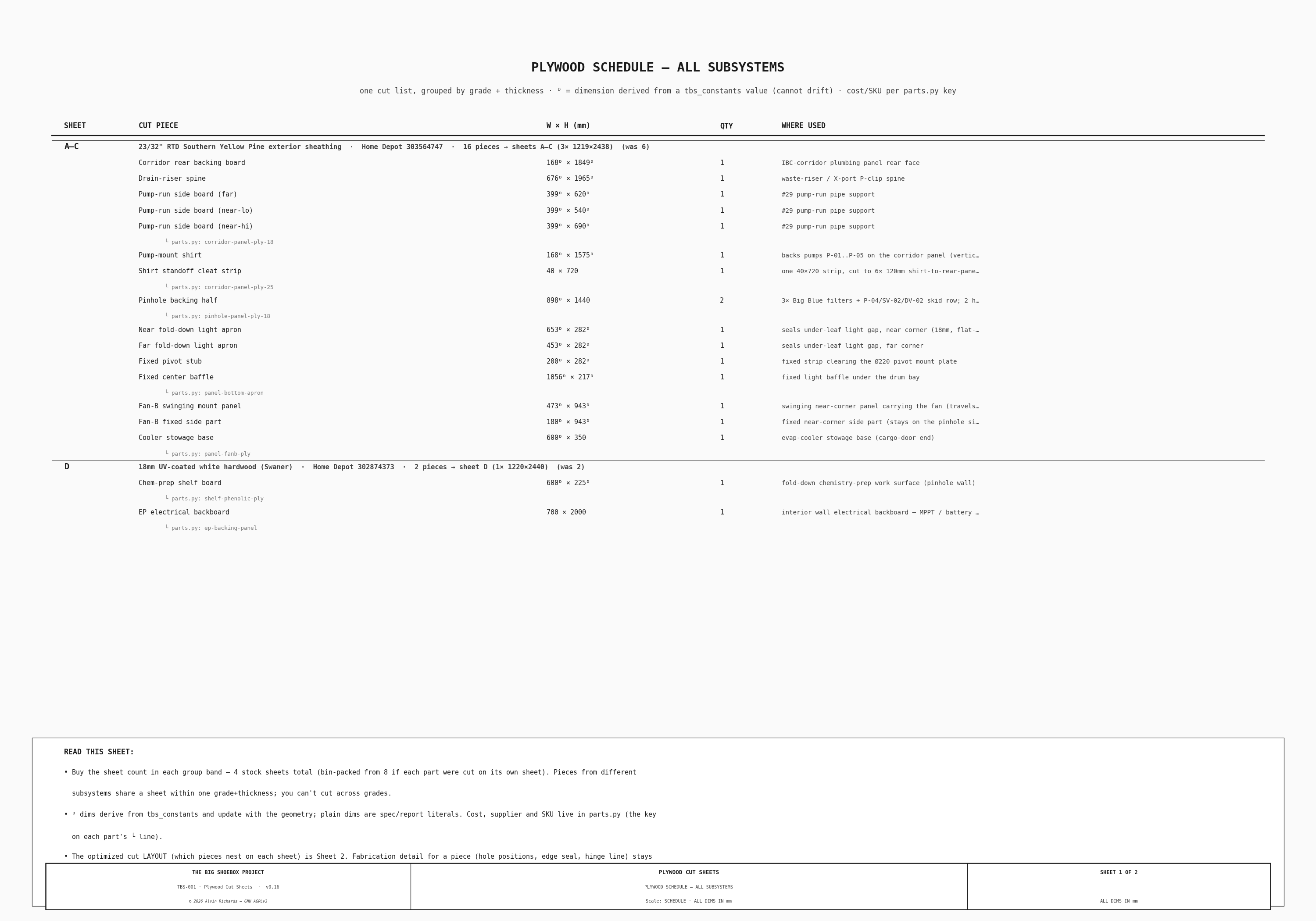
Plywood recurs across the build — the IBC-corridor plumbing panel and pump-mount shirt, the pinhole-wall filter-skid backing, the interior EP electrical backboard, the hinged light-trap panel's Fan-B mount band and fold-down light-seal aprons, and the chemistry-prep shelf. Each was previously cut ad hoc on its own subsystem drawing. This document is the single cut sheet the buyer and fabricator work from: every plywood part in one schedule, grouped by grade and thickness so same-stock parts nest on one sheet.
The cut dimensions are single-sourced. Geometry-driven pieces — the pinhole-wall panel width,
the fold-down apron widths and heights, the chem-shelf board — derive from tbs_constants and
cannot drift from the model (marked with a ᴰ on the schedule); the rest are spec/report literals.
Cost, supplier, and SKU stay in parts.py, keyed on each part's registry entry, so the money can't
drift from the procurement record. Fabrication detail for a given piece — hole positions, edge seal,
hinge line — stays on its owning subsystem sheet; this document is the stock and cut index, not the
fab detail.
2. Schedule
Every plywood cut piece, grouped by stock. The ᴰ marker flags a dimension derived from a
tbs_constants value; the parts.py key under each part is where its cost and supplier live.
3. Nesting layout
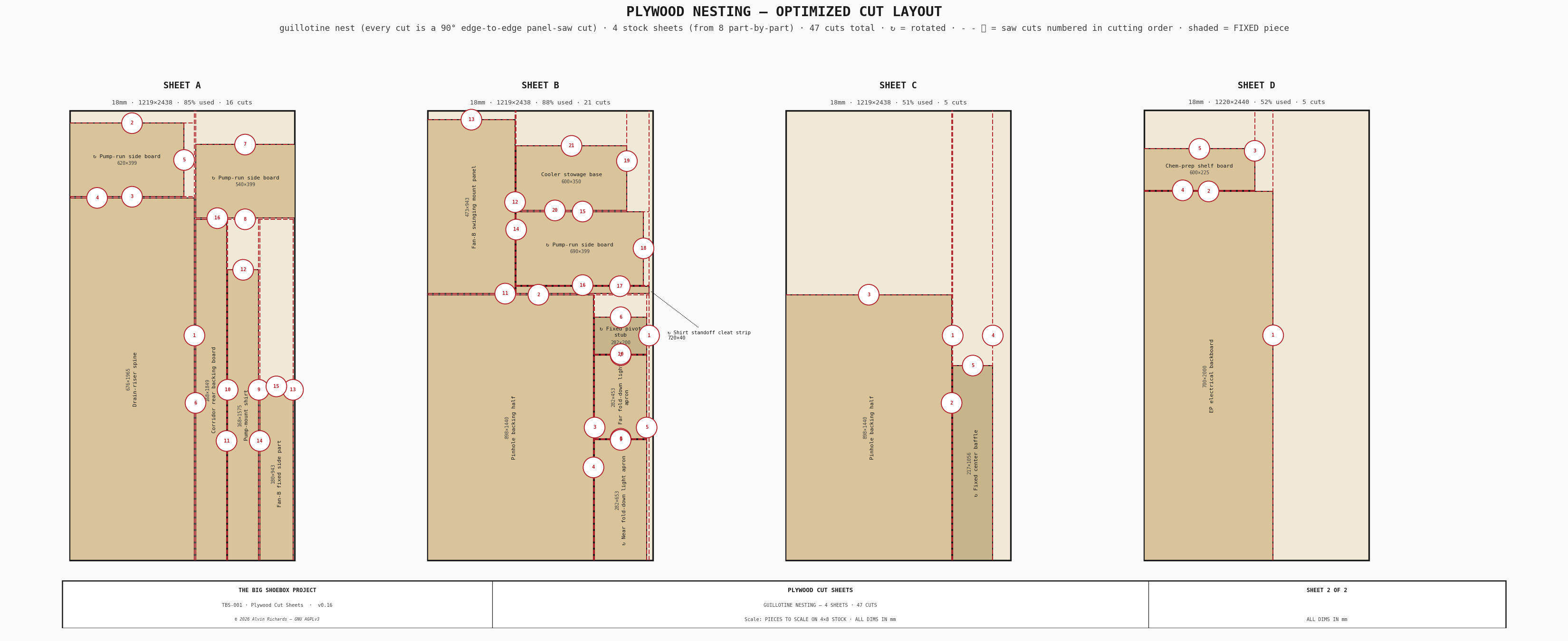
A bin-packer nests all pieces of one grade+thickness onto the fewest 4×8 sheets, mixing pieces across subsystems (e.g. the corridor panel, pump-mount shirt, pinhole-wall backing, the fold-down aprons, and the Fan-B mount band all share the Southern-Yellow-Pine sheets A–C). Every layout is guillotine-cuttable — each cut is a straight 90° edge-to-edge pass, the only cut a panel saw / sawmill makes — and the drawing shows the cut lines (dashed red), numbered in cutting order, with the cut count per sheet. The packer works to a 5mm cut tolerance: a piece may overhang a sheet edge by up to 5mm and still nest, so a near-full-width piece cuts clean to the edge rather than forcing a new sheet. It minimizes the sheet count first, then the number of cuts (the current nest is 4 sheets, 47 cuts). This packs the whole job into 4 stock sheets, lettered A–D — down from 8 if each part were cut on its own sheet. Standardizing the timber plywood on 18mm drove the consolidation: the fold-down aprons re-graded from a dedicated 12mm sheet into the SYP offcut (sheets A–C); the EP electrical backboard — a finish-agnostic backing surface — now shares the chem-shelf UV-white sheet (sheet D); and the Fan-B band + cooler base re-graded from a dedicated ¾" pressure-treated sheet into the same SYP offcut, retiring the PT sheet. So the whole job settles into two grades (SYP, UV-white). Pieces are drawn to scale; ↻ marks a piece rotated 90° to fit, dashed red lines are saw cuts, and shaded pieces are fixed (non-fold). The layout is a nesting + cut guide — the shop rips each sheet along the shown guillotine cuts.
4. Stock sheets
The four sheets are lettered A–D in the nesting layout; the schedule's SHEET column maps each cut piece to the same letters.
| Sheets | Thickness | Grade | Parts |
|---|---|---|---|
| A–C | 18mm (23/32") | RTD Southern Yellow Pine exterior sheathing | corridor plumbing panel, pump-mount shirt, pinhole-wall backing, fold-down light aprons + baffle + pivot stub, Fan-B mount band + cooler stowage base |
| D | 18mm | UV-coated white hardwood (Swaner) | chem-prep shelf board + EP electrical backboard |
| Total | 4 sheets |
Sheets A–C are one SKU, so the packer nests their parts together across subsystems (the pinhole-wall backing exceeds a single sheet's width, so it is cut as two butt-jointed halves; the fold-down aprons, the Fan-B band, and the cooler base all drop into the offcut). Sheet D's UV-white stock yields both the chem-prep work surface and the EP electrical backboard — the backboard needs only a sealed, wipeable face, which the UV coating already gives, so it rides the same sheet rather than buying its own. Sheet D is single-grade (a different finish from A–C), so it cannot cross-nest — that residual sheet is set by the grade split, not packing efficiency. Standard exterior grade throughout except the UV-coated sheet-D surface — no marine ply, and no pressure-treated (the former PT Fan-B sheet was over-spec for a dry, vented mount), since no plywood part carries a water-immersion load.
5. Source references
- Cut geometry —
tbs_constants.py(single source), drawn bygenerate_plywood_cutsheets.py. - Cost / supplier / SKU —
parts.py(timber-plyregistry entries). - Fabrication detail per piece — the owning subsystem reports: Plumbing, Electrical, Hinged Light-Trap Panel, Chemistry Prep Shelves.